
Disclosure: Some links on this page are affiliate links. We may earn a commission at no extra cost to you.
Ahrefs and SE Ranking AI Overview citation correlation datasets analyzing 75,000 brands across ChatGPT, Perplexity, and Google AI Overviews
Brand mentions correlate 3x stronger with AI citations (0.737) than traditional backlinks (0.266); 44% of AI citations originate from the top 30% of web content
In modern digital marketing, the acronym GEO carries two distinct definitions depending on context: traditional location-based Geomarketing (using GPS, IP, and geofencing to target local physical shoppers) and Generative Engine Optimization (GEO), the emerging engineering discipline of optimizing digital content and brand authority so that Large Language Models (LLMs) and AI search engines cite, recommend, and synthesize your website in direct conversational answers. While traditional Search Engine Optimization (SEO) focuses on ranking HTML pages in Google 10 blue links, Generative Engine Optimization focuses on earning citations inside AI-generated summaries across Google AI Overviews, Perplexity, ChatGPT Search, and Microsoft Copilot. Understanding how GEO, AEO (Answer Engine Optimization), and SEO interact is now mandatory for technical marketers and engineering teams facing zero-click search realities.
The GEO Definition: Disambiguating Geomarketing vs Generative Engine Optimization
In marketing discussions, the term GEO frequently creates confusion because two completely different disciplines share the same three letters. For more than two decades, marketing teams understood GEO as Geomarketing (also known as marketing geography or location-based marketing). Geomarketing uses geographic, demographic, and physical coordinate data (such as GPS, cellular tower signals, and IP addresses) to deliver localized advertisements, trigger mobile push notifications through geofencing, and optimize brick-and-mortar store discovery in local search engines.
In contrast, the rapid rise of Large Language Models has established Generative Engine Optimization (GEO) as a critical new discipline. Rather than targeting physical geographic boundaries, Generative Engine Optimization targets the neural retrieval and generation pipelines of artificial intelligence systems. GEO encompasses the technical architectures, semantic formatting patterns, entity knowledge graphs, and brand authority signals required to ensure an organization is selected, synthesized, and explicitly cited as a trusted source in AI-generated answers.
While Geomarketing answers the operational question "How do we reach customers based on where they stand physically?", Generative Engine Optimization answers the conversational question "How do we ensure AI assistants recommend our solutions when prospective buyers ask for recommendations?" Both disciplines remain active, but Generative Engine Optimization represents the primary structural shift reshaping the global search economy in 2026.
| Strategic Dimension | Geomarketing (Location-Based) | Generative Engine Optimization (GEO) |
|---|---|---|
| Core Operating Premise | Targeting consumers based on physical proximity and geography | Targeting neural retrieval models based on semantic authority |
| Primary Data Inputs | GPS coordinates, cellular triangulation, IP address ranges | Passage embeddings, Schema.org entity graphs, brand mentions |
| Delivery Channels | Geofenced push alerts, local Google Maps pack, regional ads | Google AI Overviews, Perplexity Pro, ChatGPT Search, Copilot |
| Intended Outcome | Drive foot traffic and localized regional store conversions | Earn trusted source citations and conversational brand recommendations |
| Optimization Focus | Google Business Profile, local citations, radius geotargeting | Self-contained citable passages, llms.txt, clean DOM, low TTFB |
SEO vs GEO vs AEO: The 3-Layer Modern Search Architecture
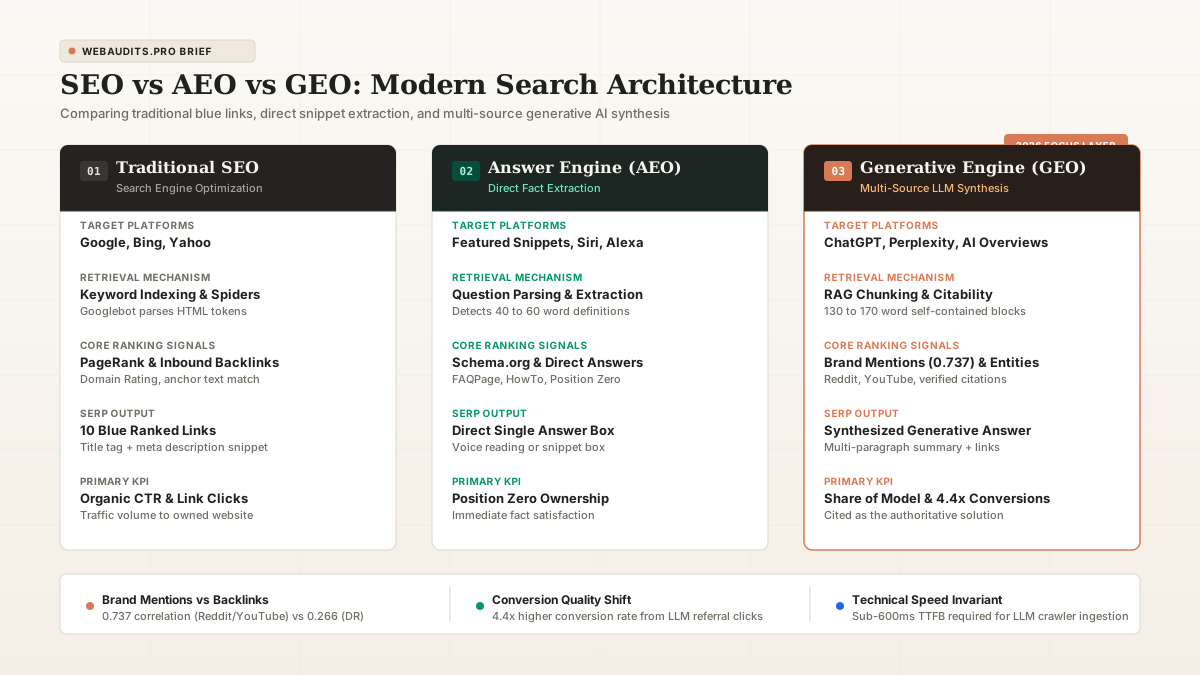
The modern search landscape has split into three distinct, complementary layers: traditional Search Engine Optimization (SEO), Answer Engine Optimization (AEO), and Generative Engine Optimization (GEO). Misunderstanding how these three disciplines fit together leads engineering teams into either neglecting AI search or abandoning core SEO fundamentals.
Traditional SEO serves as the foundational infrastructure. It is designed around web crawlers (such as Googlebot and Bingbot) scanning HTML documents, indexing textual keywords, and ranking URLs within a ranked list of hyperlinks (the traditional 10 blue links). SEO success is measured by organic ranking position, impressions, and outbound click-through rates (CTR) directing traffic to owned web properties.
Answer Engine Optimization (AEO) emerged as a bridge discipline designed to capture direct, single-fact answers. AEO focuses on structured formats (such as FAQPage schema, numbered step-by-step lists, and concise 40 to 60 word definitions) that search engines can extract verbatim for Google Featured Snippets (Position Zero), voice assistants (Siri, Google Assistant), and quick knowledge panels. In AEO, the goal is answering specific questions with immediate, definitive clarity.
Generative Engine Optimization (GEO) represents the next evolutionary step. Generative search engines do not merely present a single extracted snippet or ten separate links; they ingest dozens of candidate documents across the web via Retrieval-Augmented Generation (RAG), synthesize a comprehensive multi-paragraph explanation, and embed hyperlinked citations directly into the narrative. GEO optimizes your entire brand presence so that AI engines treat your documentation as primary reference material.
| Dimension | Traditional SEO | Answer Engine (AEO) | Generative Engine (GEO) |
|---|---|---|---|
| Primary Objective | Rank web pages in blue-link search listings | Win Position Zero and direct answer snippets | Earn brand citations in AI multi-paragraph answers |
| Target Platforms | Google, Bing, Yahoo | Featured Snippets, Siri, Alexa voice queries | ChatGPT Search, Perplexity, Google AI Overviews, Copilot |
| Algorithmic Engine | Inverted index, PageRank, keyword token matching | Knowledge Graph extraction, QA snippet parsers | Retrieval-Augmented Generation (RAG) & vector embeddings |
| Core Ranking Signals | Backlinks, anchor text, domain authority, keyword density | FAQPage schema, concise 40 to 60 word definitions | Brand co-occurrence (0.737), entity clarity, passage citability |
| Search Experience | User clicks blue link to browse website | User reads instant fact box without clicking | User reads synthesized answer with inline clickable citations |
| Click-Through Dynamics | High volume, variable intent, broad bounce rates | Zero-click on definitional queries, high voice utility | 91% to 96% lower click volume, but 4.4x higher conversion rate |
| Key Metrics | Rankings, impressions, organic sessions, CTR | Featured snippet ownership, voice share | Share of Model (SoM), citation frequency, LLM referral conversions |
The 4-Stage LLM Retrieval Pipeline: From Crawler Request to Citation Injection
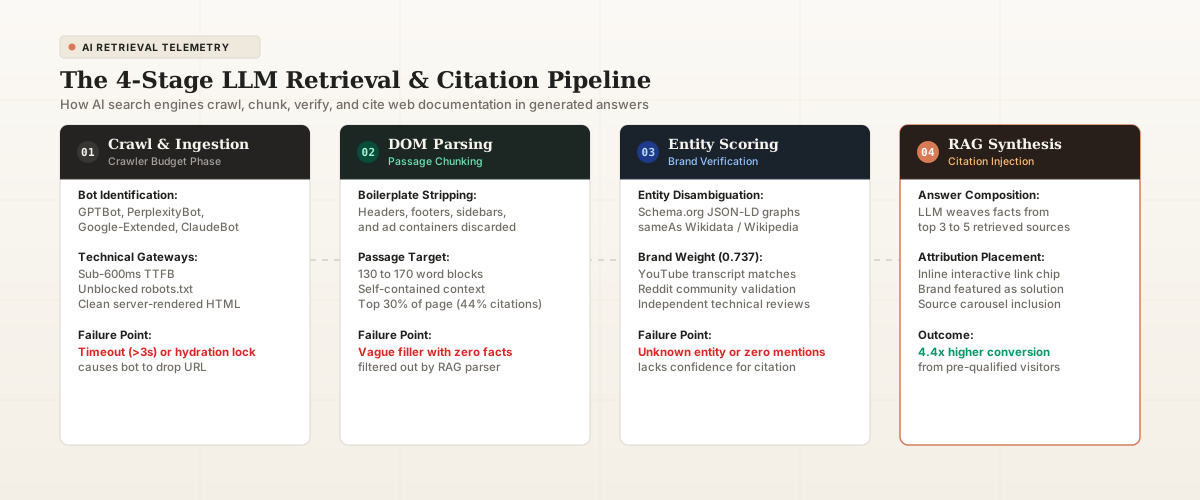
To optimize for generative AI engines, engineering teams must understand the physical mechanics of Retrieval-Augmented Generation (RAG). When a user submits a conversational prompt to an AI assistant, the model executes a four-stage retrieval and generation pipeline.
In Stage 1 (Crawl & Ingestion), the AI crawler (such as GPTBot, PerplexityBot, or Google-Extended) fetches candidate web pages. Unlike traditional search crawlers that store pages for later batch processing, real-time AI search agents enforce strict network timeout budgets (typically under 2 to 3 seconds). If your server response time (TTFB) is slow or your site blocks user agents in robots.txt, the crawler drops your URL before extraction begins.
In Stage 2 (DOM Parsing & Passage Chunking), the engine strips away navigational menus, footers, ad containers, and sidebar noise to isolate the primary body content. The parser breaks this content into semantic chunks (ideally 130 to 170 words). Empirical analysis from SE Ranking demonstrates that approximately 44% of all AI citations originate from the top 30% of a webpage, emphasizing the critical importance of front-loading factual answers above the fold.
In Stage 3 (Entity Scoring & Brand Cross-Checking), the model assesses the credibility of each candidate chunk. Independent industry studies evaluating 75,000 brands reveal that brand mentions across third-party authorities (such as YouTube transcripts, Reddit technical discussions, and established industry press) correlate at 0.737 with AI citations, compared to traditional backlink Domain Rating at only 0.266.
In Stage 4 (RAG Synthesis & Citation Injection), the LLM generates its response by synthesizing findings from the top 3 to 5 candidate chunks, attributing factual claims with interactive citation chips linking back to the source URLs.
The 4 Technical Pillars of Generative Engine Optimization
Winning consistent citations across ChatGPT, Perplexity, and Google AI Overviews requires implementing four specific technical pillars across your digital infrastructure:
Pillar 1: Self-Contained Answer Passages. Large Language Models retrieve and quote text in modular blocks. Each key section on your page should open with a self-contained answer block (130 to 170 words) that directly answers the heading query within the first 40 to 60 words. Avoid burying conclusions behind introductory throat-clearing; provide direct statistics, named tools, and clear factual definitions that can be extracted cleanly without contextual dependencies.
Pillar 2: Schema.org Entity Graphs. AI search engines rely on structured knowledge graphs to disambiguate brands, authors, and technical claims. Implement comprehensive JSON-LD schemas incorporating @type: TechArticle or Article, linking authors and organizations to authoritative external identifiers using the sameAs property (such as Wikidata, Wikipedia, and LinkedIn URLs). This eliminates ambiguity and enables the LLM to verify your institutional credibility.
Pillar 3: Unlinked Brand Mentions and Third-Party Consensus. Traditional SEO focuses on hyperlink equity. Generative engines, in contrast, evaluate semantic co-occurrence across broad training corpora and live retrieval indexes. High-authority mentions on platforms like Reddit, GitHub, and YouTube establish entity confidence far more reliably than paid directory backlinks.
Pillar 4: Machine Discovery Standards (llms.txt). Deploy an /llms.txt and /llms-full.txt endpoint in your website root. These standardized markdown files provide clean, token-efficient summaries of your documentation and product architecture, allowing AI search agents to ingest your core value propositions without wasting compute cycles parsing complex layouts.
{
  "@context": "https://schema.org",
  "@graph": [
    {
      "@type": "Organization",
      "@id": "https://webaudits.pro/#organization",
      "name": "Web Audits",
      "url": "https://webaudits.pro",
      "sameAs": [
        "https://twitter.com/webauditspro",
        "https://www.linkedin.com/company/webauditspro"
      ]
    },
    {
      "@type": "TechArticle",
      "@id": "https://webaudits.pro/articles/what-is-geo-generative-engine-optimization-vs-seo#article",
      "isPartOf": { "@id": "https://webaudits.pro/#website" },
      "headline": "What is GEO? Generative Engine Optimization vs SEO: The 2026 Guide",
      "description": "Understand what GEO means in marketing, how Generative Engine Optimization compares to traditional SEO and AEO, and the 4 technical pillars required to win AI citations.",
      "inLanguage": "en-US",
      "about": [
        {
          "@type": "Thing",
          "name": "Generative Engine Optimization",
          "sameAs": "https://en.wikipedia.org/wiki/Generative_engine_optimization"
        },
        {
          "@type": "Thing",
          "name": "Search Engine Optimization",
          "sameAs": "https://en.wikipedia.org/wiki/Search_engine_optimization"
        }
      ]
    }
  ]
}
Why Speed and Core Web Vitals Still Govern Generative Search
A dangerous misconception in modern marketing is that generative AI makes technical website speed irrelevant. In reality, server speed and performance hygiene are more critical for GEO than for legacy search.
When Googlebot crawls a website for traditional search indexing, it can queue rendering tasks in headless Chromium instances and process complex client-side JavaScript days or weeks later during secondary rendering waves. Real-time AI search engines (such as Perplexity and ChatGPT Search) operate under millisecond constraints: when a user asks a question, the model must retrieve, parse, and synthesize live web sources in under 5 seconds.
If your website relies on heavy client-side hydration, client-rendered Single Page Application (SPA) shells, or slow Time to First Byte (TTFB > 600ms), the AI retrieval bot falls back to parsing raw, unrendered HTML. If critical pricing, specifications, or conclusions are trapped behind client-side JavaScript execution, the AI model never reads them. Ensuring your server renders clean, accessible semantic HTML5 in under 300ms is the non-negotiable prerequisite for generative visibility.
# Allow Real-Time AI Search and Retrieval Bots
User-agent: GPTBot
Allow: /

User-agent: PerplexityBot
Allow: /

User-agent: ClaudeBot
Allow: /

User-agent: Google-Extended
Allow: /

# Disallow Aggressive Non-Search Training Scrapers
User-agent: CCBot
Disallow: /

User-agent: Bytespider
Disallow: /- Verify server TTFB remains under 600ms globally using edge caching or lightweight server frameworks
- Ensure primary factual content is delivered in initial server HTML, never requiring client-side hydration
- Deploy a valid /llms.txt file summarizing core products, metrics, and documentation links
- Verify that robots.txt explicitly permits GPTBot, PerplexityBot, and ClaudeBot to crawl public pages
- Audit headings to ensure H2s mirror specific user questions followed by 130 to 170 word answer blocks
- Implement comprehensive Schema.org JSON-LD markup with explicit entity linking via sameAs
Audit Your Website for AI Search and GEO Readiness
Run an instant audit with WebAudits.pro to test server response times, DOM node counts, Schema.org entity graphs, and AI crawler accessibility in under 30 seconds.
Run Free AI & Speed AuditFrequently Asked Questions
Q1:What is the main difference between SEO and GEO?
Search Engine Optimization (SEO) optimizes web pages to rank in traditional search engine results (the 10 blue links) to drive organic click-through traffic. Generative Engine Optimization (GEO) optimizes content, entity graphs, and brand authority so that Large Language Models (like ChatGPT, Perplexity, and Google AI Overviews) synthesize and cite your brand as an authoritative reference within conversational responses.
Q2:What does GEO stand for in digital marketing?
In marketing, GEO carries two definitions: traditional Geomarketing (location-based marketing utilizing GPS, geofencing, and local SEO to reach nearby customers) and Generative Engine Optimization (the practice of optimizing content and brand visibility for AI search engines and LLM synthesis).
Q3:What is the difference between AEO and GEO?
Answer Engine Optimization (AEO) focuses on structuring concise, direct factual answers (40 to 60 words) to win single-answer placements like Google Featured Snippets (Position Zero) and voice search results. Generative Engine Optimization (GEO) focuses on multi-source synthesis, positioning your brand as a trusted authority across comprehensive, multi-paragraph AI explanations.
Q4:Does Generative Engine Optimization replace traditional SEO?
No. Generative Engine Optimization builds upon SEO fundamentals. Approximately 40% of sources cited in Google AI Overviews already rank in the organic top 10 search results, and 70% rank in the top 100. Fast server response times, clean crawlable HTML, and structured schema remain mandatory for both disciplines.
Q5:How do AI search engines decide which sources to cite?
AI search engines evaluate content based on passage citability (self-contained, factual 130 to 170 word blocks), entity clarity (Schema.org JSON-LD), server response speed (sub-600ms TTFB), and external brand validation (frequent positive mentions across YouTube, Reddit, and independent technical publications, which correlate 3x stronger with citations than traditional backlinks).
Architectural Verdict & Summary
Generative Engine Optimization does not replace traditional SEO; it builds upon its technical foundation. Traditional SEO ensures search engines can crawl, render, and index your pages; AEO structures your answers for instant extraction; and GEO positions your brand as the authoritative entity cited inside conversational AI answers. Teams that combine fast server response times, semantic entity schema, 130 to 170 word self-contained passages, and active brand presence across YouTube and Reddit will dominate visibility across both traditional search and generative AI engines.